
New York City Civil Court Records
New York City civil court records span five boroughs and five counties, making this one of the most complex court systems in the country. Each borough has its own Supreme Court, Civil Court, and County Clerk who handles filings and keeps case files. If you need to find a civil case in New York City, the first step is knowing which borough the case was filed in. The NYS Unified Court System runs several free online tools that let you search for civil cases by name, case number, or filing date. You can also go to a County Clerk's office in person to look at case files during business hours.
New York City Overview
Civil Court Records by Borough
Each New York City borough has its own court system and County Clerk. Civil cases are filed in the borough where the claim arose or where a party lives. The five boroughs match up with five counties: Manhattan is New York County, Brooklyn is Kings County, Queens is Queens County, the Bronx is Bronx County, and Staten Island is Richmond County. Each county clerk keeps the official case files for Supreme Court actions in that borough.
Manhattan civil court records are held at 60 Centre Street by the New York County Clerk. The Supreme Court Record Room in Room 103B is open from 9 AM to 3 PM for in-person review. Anyone can look at case files there, with two exceptions: matrimonial files are sealed under Domestic Relations Law Section 235, and a judge may order a file sealed or impounded. E-filed documents in Manhattan cases can be viewed through the NYSCEF system without needing an account. Historic civil case files going back to 1799 are kept at the Division of Old Records at 31 Chambers Street.
Brooklyn cases go through the Kings County Clerk at 360 Adams Street. Queens filings are at the Queens County Clerk at 88-11 Sutphin Boulevard in Jamaica. Bronx civil records are at the Bronx County Clerk at 851 Grand Concourse. Staten Island records are with the Richmond County Clerk at 130 Stuyvesant Place. All five offices are open Monday through Friday, 9 AM to 5 PM.
Search New York City Civil Court Records Online
The state runs two main search tools for civil court records in New York City. WebCivil Supreme at iapps.courts.state.ny.us/webcivil/FCASMain covers all Supreme Court civil cases from every borough. You can search by party name, index number, or attorney name. It shows both active and closed cases. A case will not show up in this search unless the plaintiff filed a Request for Judicial Intervention, which assigns a judge to the case.
WebCivil Local covers the New York City Civil Court, which handles cases up to $50,000 and small claims up to $10,000. This tool lets you search by index number, party name, or judge. The Civil Court has locations in each borough. Under Judiciary Law Section 255, court clerks must search their files and make copies when you pay the right fees. The copy fee set by CPLR Section 8019(f) is 50 cents per page with a one dollar minimum.
The NYS Unified Court System records access page explains how to request records. Court records in New York are not covered by FOIL. Instead, they fall under Judiciary Law Section 255. You send your request straight to the clerk of the court or county clerk that has the records.
The screenshot below shows the NYS Unified Court System's court records access page, which outlines the process for getting civil court records in New York City and across the state.
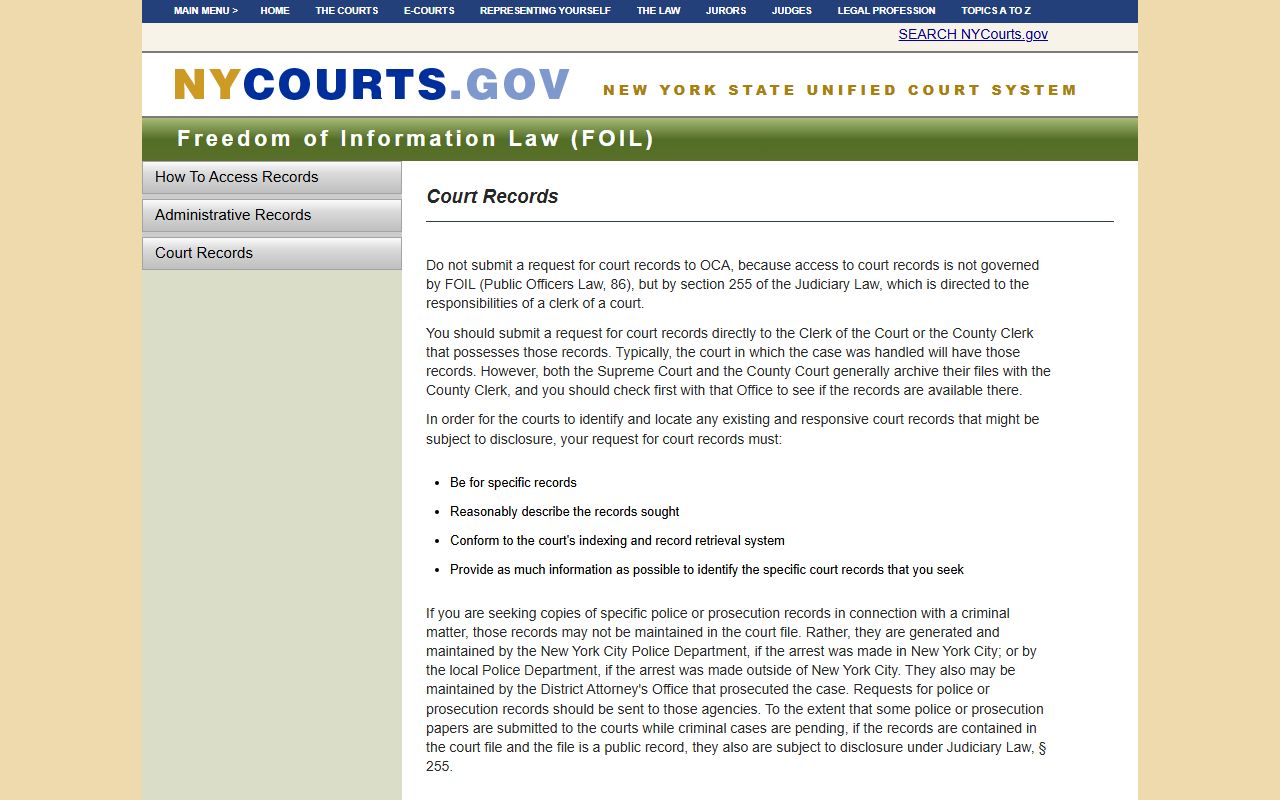
This page details how requests must be specific enough for the clerk to find the records you need.
New York City Court Record Fees
Fees for civil court records in New York City are set by state law. Under CPLR Section 8019(f), a county clerk may charge 50 cents per page for copies, with a one dollar minimum. Certifying a copy costs an extra 50 cents per page, with a four dollar minimum. These fees apply in all five boroughs. You can pay by certified check or money order made out to the right county clerk's office.
A search fee also applies. Under CPLR Section 8020(g), the clerk can charge five dollars for each two-year search period. If you want records from eight years of case history, that is four search periods at five dollars each, or twenty dollars total. In-person inspection of case files is free during business hours, and public copy machines are often available at a lower cost than the official per-page rate.
Index numbers for new Supreme Court cases cost $210. E-filing through NYSCEF is mandatory for most civil case types in New York City courts. The Criminal History Record Search through OCA costs $95 per search, though that covers criminal rather than civil records.
Note: Fee amounts can change, so check with the specific county clerk's office before sending payment for record copies.
Civil Court Records and E-Filing
Most civil cases in New York City now require electronic filing through NYSCEF, the state's e-filing platform. This system was set up under Uniform Rules Sections 202.5-b and 202.5-bb. By 2015, more than a million cases had been filed through it. One big benefit for the public is the "Search as Guest" feature, which lets anyone look up e-filed case documents without creating an account.
The official case record is still held by the County Clerk's office through its electronic database, online images, and hard copy filings. E-filed documents show up right away in the system. For older cases that were not e-filed, you may need to visit the County Clerk's office in person. The NYSCEF system does not change the rules that apply to civil cases. All CPLR rules and court rules still apply.
The CourtHelp portal at nycourts.gov/courthelp has a guide for people who need to get court records. It explains how to use eCourts for case tracking and where to send records requests for different types of courts.
The NY CourtHelp page shown below walks through the steps for getting civil court records in New York City.
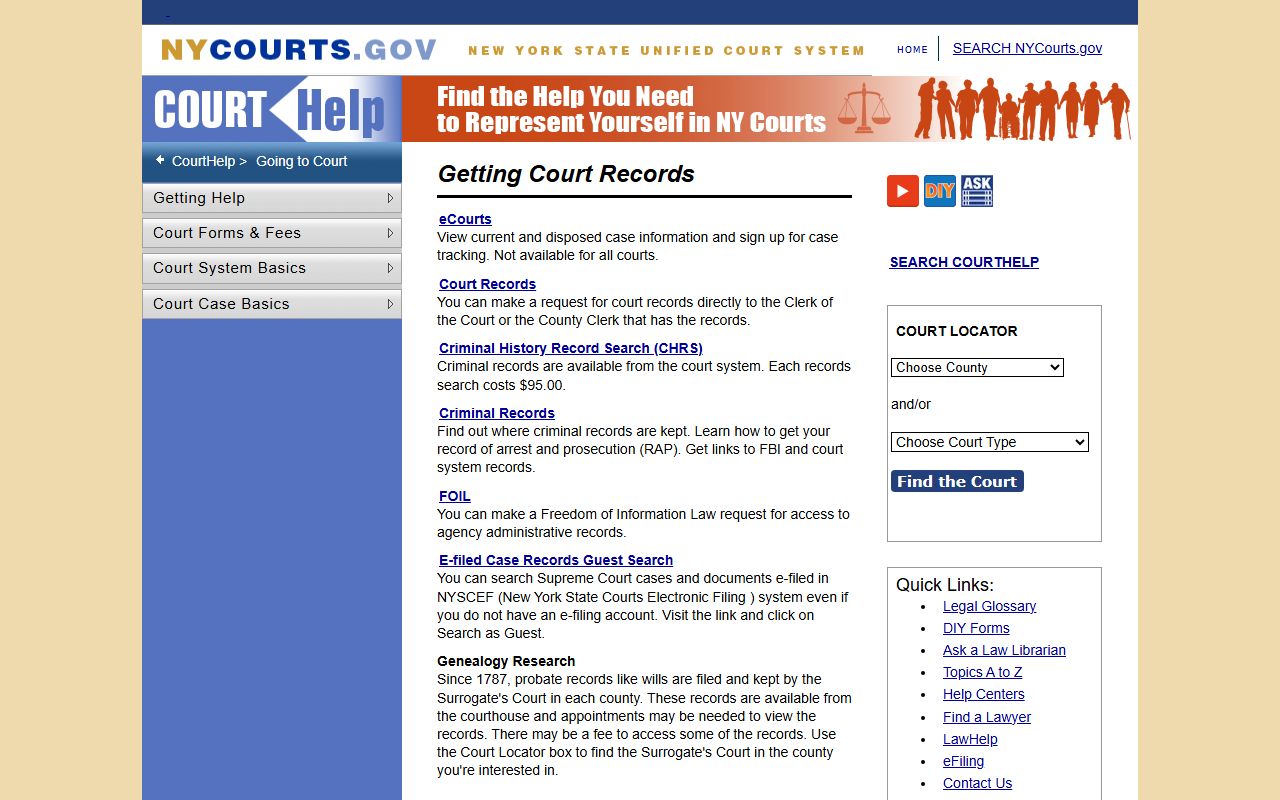
The page covers online search tools, in-person access, and how to request copies from the clerk's office.
Appeals and Higher Court Records
Civil cases that get appealed from New York City trial courts go to the Appellate Division, and some reach the Court of Appeals. The Court-PASS system provides free public access to briefs, records, oral argument videos, and decisions from the Court of Appeals. The system covers cases pending on or filed after January 1, 2013. Material on Court-PASS is updated daily and stays available permanently.
Court of Appeals decisions are posted on the day they come out at nycourts.gov/ctapps/decisions.htm. The court also archives oral argument webcasts going back to January 2010, along with transcripts from September 2012 forward. For cases before 2013, records and briefs dating to 1847 are kept at the New York State Archives.
Estate and probate records from any New York City borough can be searched through the WebSurrogate portal. This free tool covers all five boroughs' Surrogate's Courts. Document images are available for filings made on or after February 19, 2014. Adoption and guardianship cases are not shown because they stay confidential.
Sealed and Restricted Records in New York City
Not all civil court records are open to the public. Matrimonial case files are sealed under Domestic Relations Law Section 235. Only parties and their attorneys can see those records, and they must show proper ID. Divorce records stay sealed for 100 years. Family Court records are confidential under Family Court Act Section 166 and need court approval for access.
A judge can order any case file sealed under 22 NYCRR Section 216.1, but only after making a written finding of good cause. The court must weigh the public interest against the parties' privacy. Youthful offender records are sealed under CPL Section 720.35. Mental health records at any court are protected under Mental Hygiene Law Section 33.13.
Note: If you believe a sealed record should be opened, you can file a motion with the court asking for access, but the judge decides based on the facts of the case.
Nearby Cities with Civil Court Records
Several qualifying cities near New York City also have civil court records pages. Residents in neighboring areas may deal with the same county court systems or nearby judicial districts. These links can help if your case involves a location outside the five boroughs but still in the greater metro area.